Intro to Computer Systems
CMPT 295, Fall 2026
Greg Baker
This Course
It's Introduction to Computer Systems
. It contains both computer systems and computer organization concepts. (More later.)
Course web site: in CourSys, https://coursys.sfu.ca/2026fa-cmpt-295-d1/pages/ .
If you're on the waiting list: I have no control over it. You're welcome to attend lectures for the first week or so until it's sorted out.
This Course
Instructor: Greg Baker.
Office hour: Wednesdays 14:00–15:00 and Fridays 13:00–14:00, both in CSIL (probably ASB 9700, depending on other bookings).
This Course
Whoever you are, I'm glad you're here.


This Course
TAs:
- Aditya
- Alireza
- Marzieh
- Saad
Lab coverage to be announced.
This Course
Outside of office hours, the discussion forum is the best place for questions.
This Course
Greg's honest order of priority when dealing with student queries:
- In-person questions in CSIL, etc.
- Public questions in the discussion forum.
- Anything else that helps >1 student.
- Private questions in the discussion forum.
- Email.
Grading
- Weekly lab assignments: 12 × 2% = 24%
- Mini-project: 8%
- Quizzes: 2 × 15% = 30%
- Final Exam: 38%
Lectures and Labs
Lectures: as scheduled, in-person. Audio recordings (hopefully).
Labs: as-scheduled, in-person, in CSIL (ASB 9700). Submitted online.
Labs start Monday Sept 14 (i.e. next Monday).
Lectures and Labs
The lab assignments will be fairly short, but likely need >1 hour to complete.
My suggestion: at least review them and get started before your lab time; go the lab and ask any questions/clear up the details; finish before the Wednesday submission deadline.
Mini-Project
The weekly lab exercises are necessarily small and self-contained. They will focus on individual concepts.
The project is designed to force you to integrate the ideas of the course (while still being relatively small for a project
).
Mini-Project
Rough idea: take some code (from a textbook, excerpted from open source projects, written by you, etc) and evaluate them with respect to the concepts we covered in the course. Possibly try to improve it (but probably fail, because code from an established project probably doesn't have a lot of obvious places to improve).
Mini-Project
Write a 2–3 page report summarizing what you found.
The last stuff you definitely need for the project is the Tools
slides, so worry about it around then.
Quizzes/Exams
The quizzes will be during the lecture time:
- October 21 (Wednesday of week 7)
- November 18 (Wednesday of week 11)
The final exam will be whenever/wherever Student Services schedules it.
References
There is no required textbook for this course.
Possible reference material:
- Computer Systems: A Programmer's Perspective, Bryant and O'Hallaron. [SFU library]
- Additional links to be provided in the slides and on course web site.
Assumptions
- You were paying attention in the prerequisite courses.
- You are a reasonably competent C or
C++ programmer: variables, control structures, functions, using library code. - Specifically: references and heap-allocated instances (
new/delete) inC++ or pointers and heap allocation (malloc/free) in C. - Basics of a Linux command line. At least minimal fear of a command line.
Expectations
To get credit for this course, I expect you to demonstrate that you know the basic knowledge and skills of the course. That means:
- A pass on the weighted average of the stuff where you demonstrate hands-on skills: lab exercises and project.
- A pass on the weighted average of the quizzes and final exam.
Failure to do these may result in failing the course.
Expectations
That rule isn't intended to fail someone just because they get 49% on the exams: it will be applied on an individual basis with a judgement call on the question has this student has demonstrated that they understand the basic concepts of the course?
Expectations
Academic Honesty: it's important, as always. All code you submit must be created by you, not somebody else, and by hand not with some code-generating tool.
If we can tell where your code came from (another student or some tool), then it's too close to that source. Proposed rule for avoiding this: don't look at others' code and write your code at the same time.
Expectations
Examples of things that are not okay and will be treated as academic dishonesty:
- Using a tool, including an LLM, to create some code and cleaning it up a little, or having a tool
fix
your code. - Finding a solution (online or from your friend), looking at it until you really, really understand it, changing enough you think I won't notice the similarity, and submitting it.
- Sitting beside your friend and creating a single solution together, even though you're touching different keyboards.
Expectations
Working through the assigned problems is a lot of the way you're going to learn the course material. Think about labs as opportunities for learning, not for marks.
Expectations
If you're copying a solution from online, it's academic dishonesty.
If you're using a code fragment from online source (in a reasonable way where permitted by the assignment), leave a comment.
// code adapted from http://stackoverflow.com/a/...
void do_the_thing(int n) {
    ...
}
Expectations
The quizzes and exam are regular tests: individual work, closed book.
I will be asking for a grade of FD in the course for any academic dishonesty (or attempted dishonesty) on tests.
Expectations
For the quizzes and final, I will consider it academic dishonesty to have any of these in any way available to you (including in your pocket, within arm's length, under your seat, etc): phone, smart watch, smart glasses, smart ring, calculator, fitness tracker, earbuds, smart anything else that can be used to communicate or connect to the internet.
Yes, even if you promise you didn't use it. [If you have a medical device that might fall into that category, let me know before the exam.]
Computer Systems
So, what are we actually doing in this course?
Or, why is this a required course?
Computer Systems
Be honest, what's your answer to how does the code you write actually run?
My predictions…
I press F5.
The compiler… something something.
Visual Studio… does it?
I write code. Computer go brrr.
Those aren't actually bad answers: it's possible to be a good programmer without knowing much about how a computer actually runs your logic.
Computer Systems
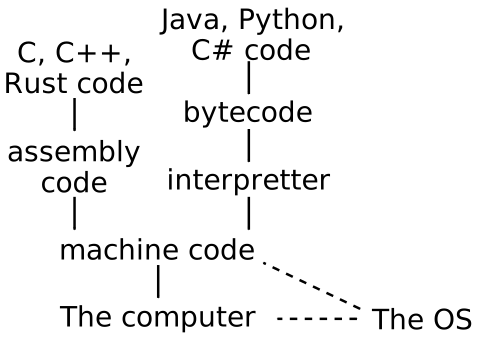
But there's a lot between your code and the computer.
Computer Systems
Many details are abstracted away from you between the editor window and the circuits that are doing the work.
That's usually okay, but there are times knowing them will let you write better code.
Computer Systems
For example, some statements that I believe are true. You should know why (and/or be able to argue that I'm wrong).
- Linked lists are (usually) bad.
- The
forloop is a bad abstraction. - Single-threaded code is slow code.
Computer Systems
These topics lead us to the boundary where the unavoidable realities of hardware meet software.
Being able to peek across those abstractions will guide you to writing better code, or understanding problems when they arise.
Hardware
Many of the things we need to do (most notably, assembly programming) are specific to the CPU architecture of the machine where it's going to run.
The details are different between ARM, x86, RISC-V, etc (but the basic concepts are the same).
Hardware
We will be writing assembly code for the x86-64 architecture. This describes systems based on mainstream Intel or AMD CPUs after about 2005.
Synonyms of x86-64
: x64, AMD64, Intel 64.
Hardware
Specifically, you need access to something slightly modern: an Intel Haswell (∼2013, Intel Core 4xxx) or later or AMD Zen (Ryzen/Epyc) CPU.
That describes all CSIL workstations and any computer that is less than about 12 years old.
Hardware
Does Apple Silicon with emulation
meet that criteria? Maybe… probably… often? [I don't have one.]
Most of your work can definitely be done in a Linux VM. There may be some problems where real hardware is necessary: remoting into CSIL would be the best solution then.
Hardware
All examples will be in Linux. All submitted code must work in Linux. You should work in Linux.
No support can be provided for anything else, and many of the tools we need aren't available anywhere else.
tl;dr Linux.
But, same answer about VMs (including WSL): usually okay but sometimes a real-hardware test might be needed.
Hardware
There will be many examples in C (and
There's nothing special about C here: I can imagine a different CMPT 295 that uses Rust or any language that has a good machine code compiler.
I'll try to say C
and C or Rust or something else compiled to machine code
as appropriate, but will probably often forget.
Hardware
Basically: in some alternate universe, I'm teaching this course with Rust on ARM. The topics, themes, and learning outcomes would be the same.
In this universe: x86-64 and C.
Topics
- Computer architecture: the parts of a computer, what they're for, and how they interact
- Assembly programming
- C vs assembly
- Representing information in binary
Topics
- Memory architecture
- cache, memory, virtual memory
- CPU tricks
- vector processing
- pipelining
- branch predictionm
- Compiler optimization and hand-optimizing code
- Concurrent and parallel code
Topics
Why do I care about any of this?
Running code has a cost, no matter what: in time, electricity, battery life, CO2 emissions, cloud provider bills, etc. Seeing through some of these abstractions let you write more efficient code that's cheaper (in whatever way). We'll talk about some ways to do that.